


Flame Resistant Clothing Guide: Understanding FR Standards, Safety Icons & Certifications
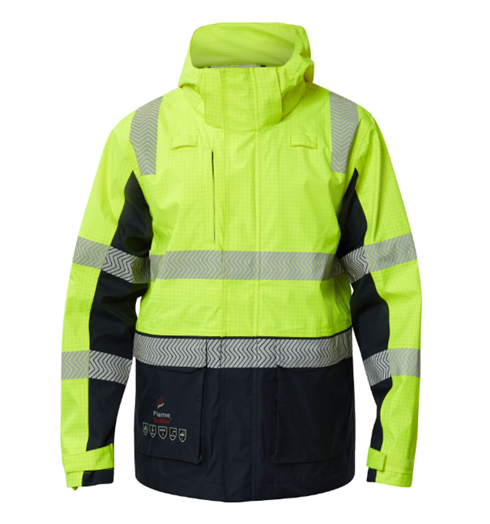
A flash fire or arc flash can change everything in seconds. That is why Safe Work Australia’s message counts:
"All workers have the right to a healthy and safe working environment and any workplace death is unacceptable."
The right clothing can have a massive impact. In 2023, there were 200 workplace fatalities reported in Australia; choosing compliant protective clothing means keeping workers safe and protected.
Australian workers in mining, utilities, construction, oil and gas, electrical maintenance, and heavy industry face arc flash, flash fire, molten metal, and heat exposure. These risks can cause severe burns in seconds. SafeWork SA has repeatedly flagged the risks that come with work performed on or near live electrical systems. Flame-resistant (FR) clothing exists precisely for these moments, not to prevent the hazard itself, but to buy a worker the seconds they need to get away from the hazard.
Many workers recognise high-visibility colours on site, but very few can explain the technical symbols and certification marks printed on FR garments. These icons indicate that the garment has been independently tested to meet specific requirements and how it behaves under heat or flame. Understanding them affects both worker safety and procurement confidence.
Choose the right FR clothing to reduce burn risks and meet site requirements.
What is Flame Resistant Clothing?
Flame-resistant clothing is apparel that protects and resists ignition. Once you remove the source of ignition, it also self-extinguishes. FR clothing can limit how far a burn can spread, not like ordinary fabrics that can continue burning. This is why they are a necessity for workers exposed to heat events such as arc flash, flash fire, sparks, and other short-duration heat events.
These terms are used interchangeably by manufacturers:
-
Flame Resistant – an inherent property of the fabric itself; it resists ignition and won't sustain a flame.
-
Fire Resistant – a broader, less precise term often used interchangeably, without a single testing standard behind it.
-
Flame Retardant – usually a chemical treatment applied to a fabric, rather than a built-in fibre property.
Treated fabrics can lose protection over repeated washing, while inherently FR fibres hold theirs for the garment's life.
Not sure which garment fits your hazard? Browse WorkArmour's FR clothing range and filter by standard, or talk to our team for a quick recommendation based on your site's specific risks.
Why Safety Icons Matter
Every NFPA, ISO, or IEC symbol on FR clothing represents a standard that has been tested. These symbols give buyers the confidence that the garment is suitable for a certain hazard, and it gives workers a clearer idea of what protection they are wearing— heat exposure or arc simulation. These safety icons make it easier to match garments to site rules.
These icons document compliance. Many Australian industrial sites mandate these garments and won't admit a worker without specific certifications. Even insurers expect documented PPE standards. A single garment commonly carries three or four certifications at once because workers often face several hazards in one shift.
Understanding the Most Common FR Safety Icons
Common FR Safety Icons
|
Safety icon |
Meaning |
Protects against |
|
NFPA 2112 |
Standard for flash fire-resistant protective clothing |
Flash fire exposure and short-duration thermal hazards |
|
ISO 11612 |
Protective clothing against heat and flame |
Convective heat, radiant heat, limited flame exposure, molten splash |
|
IEC 61482 |
Protective clothing against the thermal hazards of an electric arc |
Arc flash and electric arc heat exposure |
|
AS/NZS 4602.1 |
High-visibility safety garments standard |
Day and night visibility on work sites |
|
ATPV |
Arc Thermal Performance Value |
The incident energy level a garment can withstand before causing a second-degree burn risk |
|
HRC / PPE Category |
Arc flash hazard rating system |
Helps match PPE to the level of electrical hazard |
|
UPF 50+ |
Ultraviolet Protection Factor |
Harmful UV exposure from the sun |
Understanding Australian and International Standards
NFPA 2112
NFPA 2112 is a US standard for flash fire-resistant clothing. It is usually specified by Australian mining, oil and gas, and industrial employers because it is a benchmark for thermal protection. Certification involves fabric checks, heat transfer testing, thermal shrinkage testing, and manikin burn testing, where an instrumented mannequin measures predicted burn injury.
ISO design guidelines
Many premium FR garments use ISO performance principles for manufacturing. ISO 11612 sets heat and flame requirements using letter-and-number codes such as: A1/A2 for limited flame spread, B1–B3 for convective heat, C1–C4 for radiant heat, D1/D2 for molten aluminium, E1–E3 for molten iron, and F1–F3 for contact heat. This lets buyers match protection to the hazard.
AS/NZS 4602.1:2011
AS/NZS 4602.1:2011 is for high-visibility safety garments. This is important for workers who need to be seen in daylight or at night. The standard considers fluorescent fabric for day visibility and reflective tape for night visibility. That is why many FR garments combine flame resistance with hi-vis compliance. This is important for workers in transport, civil works, utilities, and roadside environments.
HRC, PPE category, and ATPV
Arc-rated clothing is often described using HRC, PPE category, or ATPV. HRC refers to hazard risk categories. PPE categories match the garment to the expected arc flash energy level. ATPV is measured in cal/cm². It indicates how much incident energy a fabric absorbs before a 50% probability of a second-degree burn. The HRC/PPE Category translates that figure into practical tiers. The table below gives a simple overview.
|
PPE category |
Minimum arc rating |
Typical use case |
|
Cat 1 |
4 cal/cm² |
Low-risk electrical tasks |
|
Cat 2 |
8 cal/cm² |
Moderate electrical maintenance |
|
Cat 3 |
25 cal/cm² |
Higher-energy electrical work |
|
Cat 4 |
40 cal/cm² |
Highest common arc flash exposure tasks |
Why UPF 50+ matters
UPF 50+ means the garment blocks most harmful UV radiation. This is a major benefit for Australian workers who spend long hours outdoors. This is relevant in mining, construction, utilities, agriculture, and civil projects. So a UPF 50+ rating blocks most UV radiation from reaching the skin.
FAQs
What does ATPV mean on FR clothing?
ATPV stands for Arc Thermal Performance Value. It shows the heat energy level a garment can withstand before a burn threshold is reached.
What is HRC 2 protection?
HRC 2 generally refers to a moderate arc flash hazard level. It requires clothing with an arc rating suitable for that risk. It requires at least 8 cal/cm² for routine maintenance rather than high-energy switching.
Is NFPA 2112 recognised in Australia?
Yes, it is recognised and specified by Australian employers. Despite being a US standard, heavy industrial employers specify it for its rigorous testing, especially in mining, oil and gas, and heavy industry.
What is NFPA 70E?
NFPA 70E is a workplace electrical safety standard. It controls risks such as shock and arc flash. In simple words, it is a US workplace standard for electrical safety and safe work practices around energised equipment.
Is high-visibility clothing automatically flame-resistant?
No, high visibility and flame resistance are different protections. They are also tested and certified separately; visibility says nothing about flame behaviour. So, a garment must be tested and labelled for both if both are required.
Can one garment comply with multiple safety standards?
Yes, many FR garments comply with FR, hi-vis, arc rating, and UV certifications together. Each is tested independently.
Choosing the Right Protection(Conclusion)
Reading an FR label properly requires some know-how. Icons and standards exist so workers and safety managers can agree on exactly what a garment protects against, not to complicate a purchase decision. In the end, it is about reducing injury risk and helping workers stay safe in harsh environments.
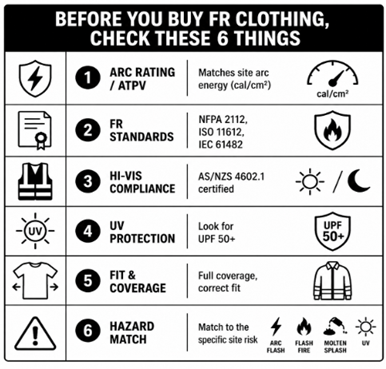
WorkArmour's flame-resistant workwear range combines FR protection with hi-vis compliance and UV protection where sites demand it. If you recommend PPE for a crew working near arc flash or flash fire, check the certification labels before the purchase order goes through.
Please complete your information below to login.
Sign In
Create New Account